New NABERS Waste Ruling V2.1 (June 2025): What You Must Know
Content
In June 2025, NABERS released version 2.1 of the Waste Rules, introducing several important changes that building owners, facility managers, and assessors need to be across.
If your building needs a NABERS Waste rating, or will soon, these updates matter. They affect how you collect data, how you prove your recycling performance, and how assessors judge your rating.
Let’s break down the changes and discuss what this means for you, your buildings, and the essential next steps to stay ESG compliant.
1. Key Changes in NABERS Waste Rules V2.1
1.1 External Bin Weighing Becomes Mandatory
From 1 January 2026, internal tenant-level bag weights will no longer be accepted as primary data. Instead, sites must weigh full external bins at the Base Building collection point before they are serviced.
In the past, cleaners could weigh small rubbish bags inside the building (for example, at each office floor) and use that data for a NABERS rating. That’s no longer allowed. Now, only the weights of full large bins (external bins), i.e., the ones in the waste room or loading dock, presented for collection by the truck, are accepted.
Deadlines:
- Affected sites have until 31 December 2025 to transition.
- From 1 January 2026, tenant bag weights will not be accepted at all.
- Extensions may be requested, but only with written justification and NABERS approval.
Why This Change Was Made
Bag weights were messy and unreliable. Sometimes bags weren’t weighed, sometimes waste was added later, and sometimes numbers didn’t match what the truck collected. External bins are the final point before the truck takes the waste away, so weighing them gives a much truer picture of what leaves your building.
1. 2 Dry Waste Recycling Requirements Are Tougher
NABERS has clarified the definition of “Dry Waste” and tightened what counts towards recycling. To include Dry Waste as a valid recycling stream, a site must now demonstrate that both General Waste and Organics streams are in place and working. Previously, NABERS allowed buildings to get credit if they had only one or the other stream active. That’s no longer enough.
Why This Change Was Made
Food/organic waste is one of the biggest causes of landfill. Without organics recycling, many buildings had inflated recycling numbers that didn’t reflect reality. This change reflects NABERS’ shift toward a more holistic picture of diversion and contamination, and forces buildings to capture and recycle organics properly.
2. How Bintracker & Gurru Support Compliance with NABERS Waste v2.1
These new requirements put data accuracy at the heart of NABERS Waste. Bintracker is purpose-built to help buildings transition smoothly:
2.1 Record External Bin Weight at Collection Point
NABERS v2.1 makes external bin weighing at the collection point the only accepted method for ratings. Bintracker integrates with on-site smart scales so cleaners can weigh full external bins at the Base Building collection point with ease. The system automatically records weights, timestamps, and user IDs, eliminating manual entry errors and providing the verifiable data NABERS now demands.
The platform also supports internal vs. external data separation. Cleaners can still capture internal bag weights for tenant-level insights, while external bin weights remain the official record for NABERS. Both data sets are stored separately, making it easy to filter, compare, and validate accuracy without confusing staff or duplicating effort.
How Bintracker Helps
Essentially, with Bintracker, you have the options to do both: comply with NABERS’ mandatory rule while still keeping valuable tenant-level reporting intact.
Switch between “Internal” and “External” tabs to view and compare all waste data in one place (via Bintracker dashboard).
2.2 Tailored Tablet Mode to Capture All Streams
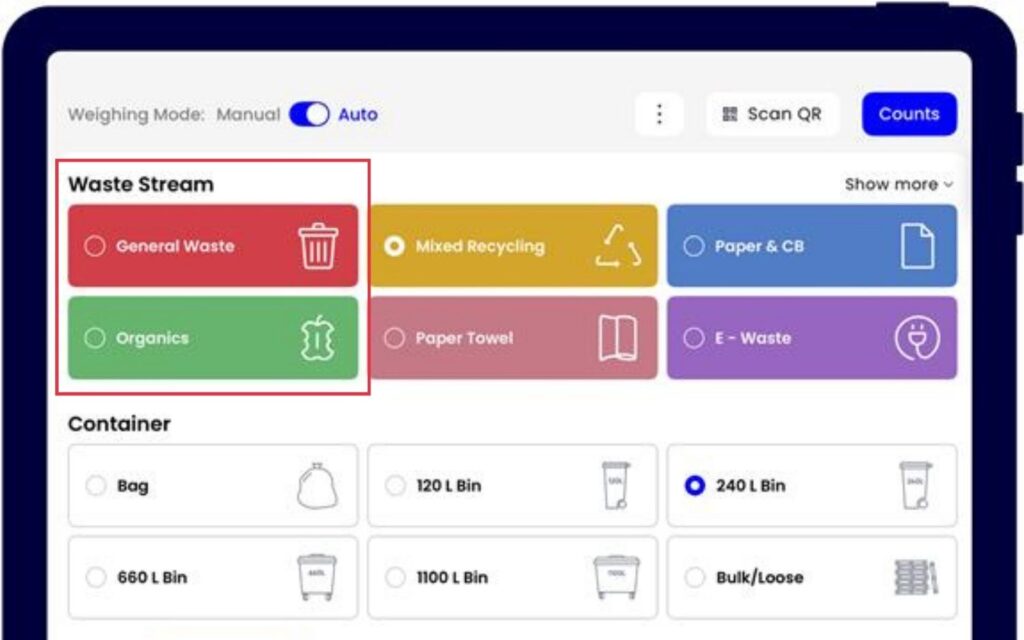
Under NABERS v2.1, buildings must now show that both General Waste and Organics streams are in place and functional. Bintracker makes this simple.
In tablet mode, cleaners just select the stream (e.g. general waste, organics, mixed recycling, e-waste) and record the weight. The app can also be customised to highlight organics and dry waste, so these streams are never missed during collection.
All of this data flows directly into the reporting process, giving you clear evidence that your site meets the updated NABERS requirement, while also improving data quality and reducing errors.
How Bintracker Helps
Customise ‘Table Mode’ to suit your site’s specific needs.
3. Get Ahead of NABERS V2.1
These rule changes put a sharper focus on data integrity. External bin weighing and verified dockets reduce the risk of inaccurate reporting, while expanded Dry Waste requirements align assessments more closely with circular economy goals. Sites that prepare early (by updating waste contracts, engaging cleaners, and ensuring robust data capture) will be better positioned for smooth NABERS assessments in 2026 and beyond.
Don’t wait until the deadline. Start preparing now:
- Transition cleaners to external bin weighing.
- Confirm your organics recycling is active and effective.
- Partner with experts to verify your supply chain.
At Gurru, our Bintracker platform and NABERS Accredited Assessors are ready to help you adapt quickly and confidently.
Book a consultation today
Learn more about Bintracker’s features
Read the Complete Guide to NABERS Waste.
Stay compliant. Stay competitive. Stay ahead.

Yining Su
Senior Waste Consultant (NSW) & Head of Building Performance | NABERS Waste Accredited Assessor and TRUE Waste Advisor
Yining holds a Ph.D. in Geography from the University of Hong Kong, where she researched influences on public environmental behaviour. She has published several peer-reviewed articles and also holds M.Eng and B.Eng degrees in Landscape Architecture.
Sheridan Kelly
Senior Waste Consultant (QLD) & Head of NABERS | NABERS Waste Accredited Assessor and TRUE Waste Advisor
Sheridan has 10 years of experience in waste management with Veolia and Cleanaway across hydrocarbons, solid waste, and hazardous waste. She holds a B.Sc. in Environmental Science and is a NABERS Waste Accredited Assessor.
Keep Up-to-Date
- Latest @ Gurru
- Industry News
- ESG/Waste Regulation Updates
Don’t just collect data — clean it, confirm it, action it.
Or let us handle the heavy lifting.
Discover how NABERS Waste works, rating criteria, costs, data requirements, and strategies to improve your score. A full guide for building owners & FMs.

Australia’s waste and recycling system is changing quickly, with new policies and initiatives affecting how we handle resources. In this edition of the Word on Waste Newsletter, learn about the latest industry updates, including important reductions in food waste and increasing waste fees. Discover the hidden effects of microplastics on our environment and health, along with tips to cut down on plastic use in your daily life.

Breaking down what reliable waste reporting means for NABERS, why it matters, and how better data can support stronger performance better results.